





Frequently Asked Questions
FAQ
Here we answer frequently asked questions about our business philosophy and who the coffee makers are.
Kaffeemacher GmbH has existed since January 1, 2017. Café frühling and the Kaffeemacher Academy were previously projects that emerged from the company mitte Kontext. Today, the company mitte is merely a customer of the roastery and academy. The coffee makers and Café frühling have not been affiliated with the company mitte since early 2017 and form their own GmbH. Profits are not distributed to shareholders but invested along the value chain.
We are co-owners of a coffee farm (Finca Santa Rita) in Nicaragua. We operate a coffee academy and a coffee roastery in Münchenstein. Gastronomically, we are active with our Café frühling in Kleinbasel, as well as the Café at SBB train station. In addition to the physical coffee shop at Klybeckstrasse 69, we operate two online shops: the Swiss shop and the shop for Germany and the EU.
The basic idea of Santa Rita is to stabilize a small coffee farm and prepare it for future challenges (climate, low coffee prices, quality). Since August 2017, we have been co-owners with Roberto Castellanos (previous sole owner). We are financially involved with 50% in investments, losses, and profits. On-site, we have a local team that manages day-to-day operations. Finca Santa Rita is located in Nueva Segovia, Dipilto, near the border with Honduras.
We do not forgo labels, but we see great added value in building and maintaining a personal relationship with coffee producers. Understanding the challenges and problems of coffee producers helps us respond precisely to individual needs and find creative solutions together.
Coffee is an extremely sensitive plant. Not every producer has the experience or access to a market that would allow risky production of organic coffee.But we ourselves believe in a future of organic agriculture and actively support producers who want to develop in this direction. We are involved in a project in Honduras on biodynamic coffee cultivation and go even further than classic organic coffee production. On Santa Rita, we don't make organic coffees, but we try to build awareness with our partners. We try to use as few synthetic means as possible and as much as necessary.
We deliberately avoid buzzwords like "direct" because the concepts are too imprecise and therefore hard to grasp. We try to be as close as possible to the producers, to understand their challenges and problems, and to find creative solutions together. We don't rely on terms; we let our actions speak for themselves.
For us, fairness is not a state but a process that must be renegotiated again and again. Fair Trade guarantees producers a minimum price of $1.40/pound, but this price does not necessarily reflect actual production costs. We orient ourselves, whenever possible, to the actual production costs for green coffee and often pay double to four times the Fair Trade price. Through our intensive collaboration with coffee producers, we form our own picture of living and working conditions on-site.
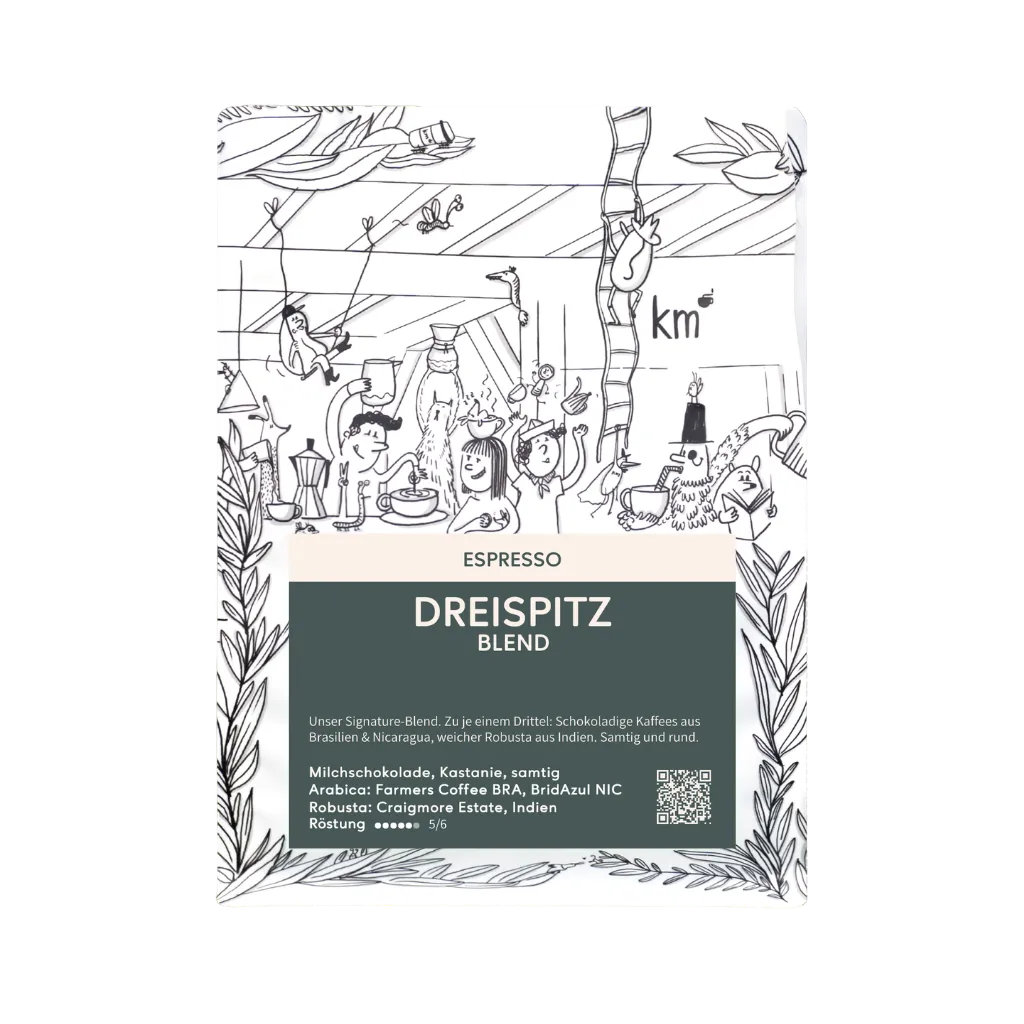
Arabica and Robusta are different coffee species (comparison: apple - pear). With both Arabica and Robusta, there are better and worse qualities. Arabicas are generally milder and more aromatic, while Robustas are more astringent and stronger in taste. In all our blends, we use a washed Robusta from India. Robusta has twice as much caffeine as Arabica.
We roast high-quality coffee in small batches. For our green coffees, we pay at least two to four times more than the coffee exchange price.
We always roast our coffees fresh and recommend 7 days of degassing time for filter coffee and at least 12 days for espresso. Coffee that is too fresh lacks aroma and is too acidic. We recommend consuming the coffee within 2 months but guarantee a minimum shelf life of 6 months.
An extensive list can be found here: