




Gutsch - the Swiss organic oat drink

In November 2021, the Gutsch cooperative launched the first Swiss organic oat drink specifically developed for coffee beverages. We co-founded the cooperative with other coffee companies. With this, we are setting a signal for Swiss organic agriculture, more conscious consumption, and meaningful collaboration with other companies.
"Water from Schlieren instead of Sweden" was long the Gutsch internal motto, until it became more and more known and eventually served as a conversation starter with interested parties. An oat drink consists of approximately 90% water, the rest being processed oats, oil, salt, and in the case of Gutsch, red algae. Soyana in Schlieren near Zurich fills the drink for Gutsch, which is also where the water comes from.
Oat drinks, which are extremely valued especially in the specialty coffee industry, largely come from England, Sweden, or Denmark. The oat drink market is moving very quickly right now and becoming increasingly differentiated, with new products coming to market every year.
In Switzerland, Soyana's products are very widely distributed; we served them for years in the Café Frühling and at the Kaffeemacher Café at SBB Basel. Emmi recently launched Beleaf, an oat drink with Swiss oats (non-organic), and according to industry experts, further drinks are to come to market.
So it was hardly surprising that we got an early rejection from Gutsch from a large organic retailer saying they were not interested in resale. Fortunately – because this fundamentally shaped Gutsch's approach. We had to find channels other than resale to wholesalers.
Oat drink from Switzerland – still extremely rare
Gutsch is not the first organic oat drink with Swiss oats – the drink from Lebenshof Aurelio quickly gained many fans, as did the oat drink from Biohof Hübeli. These projects were the first in Switzerland to use organic oats. There are likely to be more products very soon, and above all, the market is now becoming interesting for the larger bottlers as well.
With Gutsch, we had a clear focus: we wanted to reach gastronomy – we wanted to go where we ourselves saw a need. Where we have contacts, where we knew what the requirements were for an oat drink in the coffee industry. So we took the suitable alternative into our own hands. And Gutsch had to be organic – that was always clear.

Photo: Boris Müller, from the Tages-Anzeiger Instagram channel
Gastronomy in focus
We statutorily established with Gutsch that we would not go into classic retail. The first inquiry from a supermarket came just six days after launch – so the demand for a Swiss organic oat drink is definitely there.
To be able to sell the large quantities of private label production at all, we served gastronomy channels from the start. This allowed us to supply various cafés and restaurants with our first three test batches of 50,000 liters and get direct, unvarnished feedback. A week after the launch in November 2021, we were already supplying Gutsch to over 30 establishments. All businesses serving Gutsch are members of the cooperative – that's a requirement.
The Gutsch Cooperative as Foundation
We chose the cooperative model because we see Gutsch as a community project. Equal rights, equal votes, lots of grassroots democracy. A membership in the cooperative is obtained with a share certificate of 500 CHF (companies) or 250 CHF (sponsors). We used this model of share certificate distribution as start-up capital. We tried not to set up Gutsch like a food startup. This eliminated the model of outside investment. At the same time, we wanted to have the people at Gutsch's helm who carry Gutsch forward – and those are the cooperative members.
Soyana – the private label bottler for Gutsch
Within a year, Gutsch was market-ready. From the first conversations with Soyana, to recipe development, to design, to setting up the supply chain. Leading this were Philipp Schallberger (Kaffeemacher) and Mathias Bühler from Adrianos Coffee Roastery in Bern.
Soyana is a pioneer of plant-based drinks in Switzerland. Founder Walter Dänzer was a friend of the Gutsch project from the beginning and is now himself a cooperative member.

Soyana CEO Walter Dänzer in conversation with Sascha Britsko from Tages-Anzeiger
The article from Tages-Anzeiger from November 5 is available via this link: Gutsch Report
The Design – Final Project by Sara Dietrich
With Gutsch, we wanted to take different paths, including in design. Sara was just before her bachelor's degree at the Design & Art University in Lucerne. We got in touch with Sara and she took on Gutsch. Sara designed the entire brand language, typography, corporate design, website, and: the "actual" packaging.

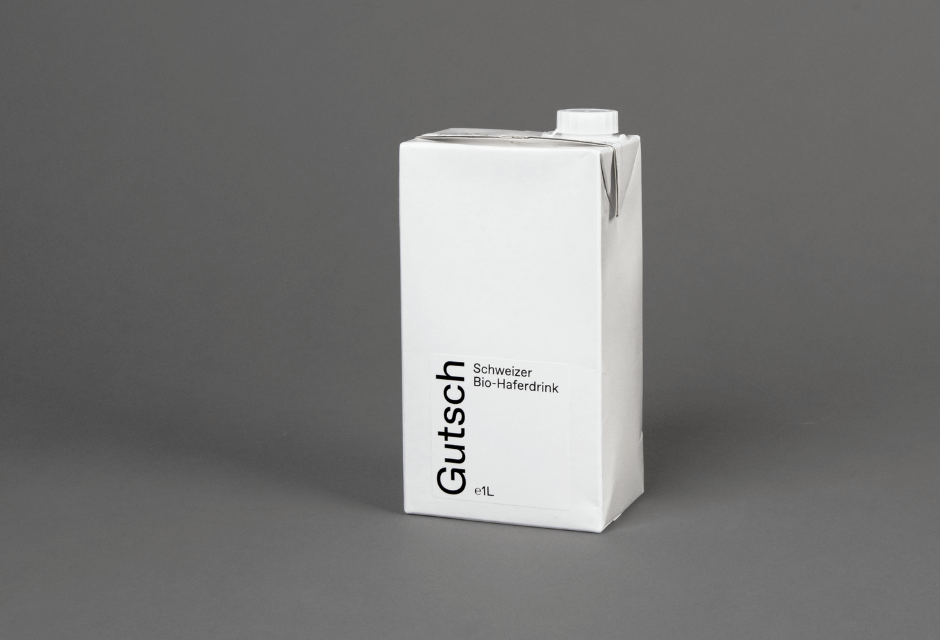
But why does Gutsch now simply look white?
As so often, it's for technical reasons. The minimum order quantity for custom packaging is several hundred thousand. We didn't want to make this investment and looked for alternatives. The white packaging is now the blank that the manufacturer provides to us. Feedback from production was mixed; it looked "quite special" – we knew then that it fit.
Sara Dietrich's entire work can be viewed here .
Will we ever fill Gutsch in Sara's packaging?
The white packaging is a temporary solution that we really like by now. It's simply different. Sara's packaging is the goal – the more of you all drink Gutsch, the closer we get to filling Gutsch in the future in Sara's Tetrapaks, inspired by Swiss industrial design from the 1970s.
Gutsch – where to buy? And how much does Gutsch cost?
- The Gutsch cooperative sells to its members
- Members serve Gutsch in their establishments and/or can resell Gutsch to private customers.
- List of sales outlets
Prices for end consumers are between 3.70 to 3.95 CHF/l. Each business decides on the sales price within this range based on its own costs.
The sales price of Gutsch to cooperative members varies between 2.40 CHF/l to 2.80 CHF/l, depending on the quantity ordered.
The Gutsch Cooperative
More benefit for everyone – that's what we decided at Gutsch . The more businesses that participate in Gutsch, the better the terms become for everyone. That's the goal of a cooperative. On our website we write:
Together we go further. The more people participate in the Gutsch cooperative, the more attractively we can design the conditions for everyone. The cooperative has the signaling effect of a movement. The more cafés across Switzerland join forces for the same cause, the more incentives are created for the production of organic oats. And we all benefit from that.
- Co-CEOs Mathias Bühler and Philipp Schallberger Kaffeemacher
-
Further links:
Tages-Anzeiger Report: https://www.tagesanzeiger.ch/jetzt-kommt-die-schweizer-biohafermilch-890018745704
Article by Benjamin Hohlmann: https://www.benjamin-hohlmann.org/blog/gutsch-hafermilch/