


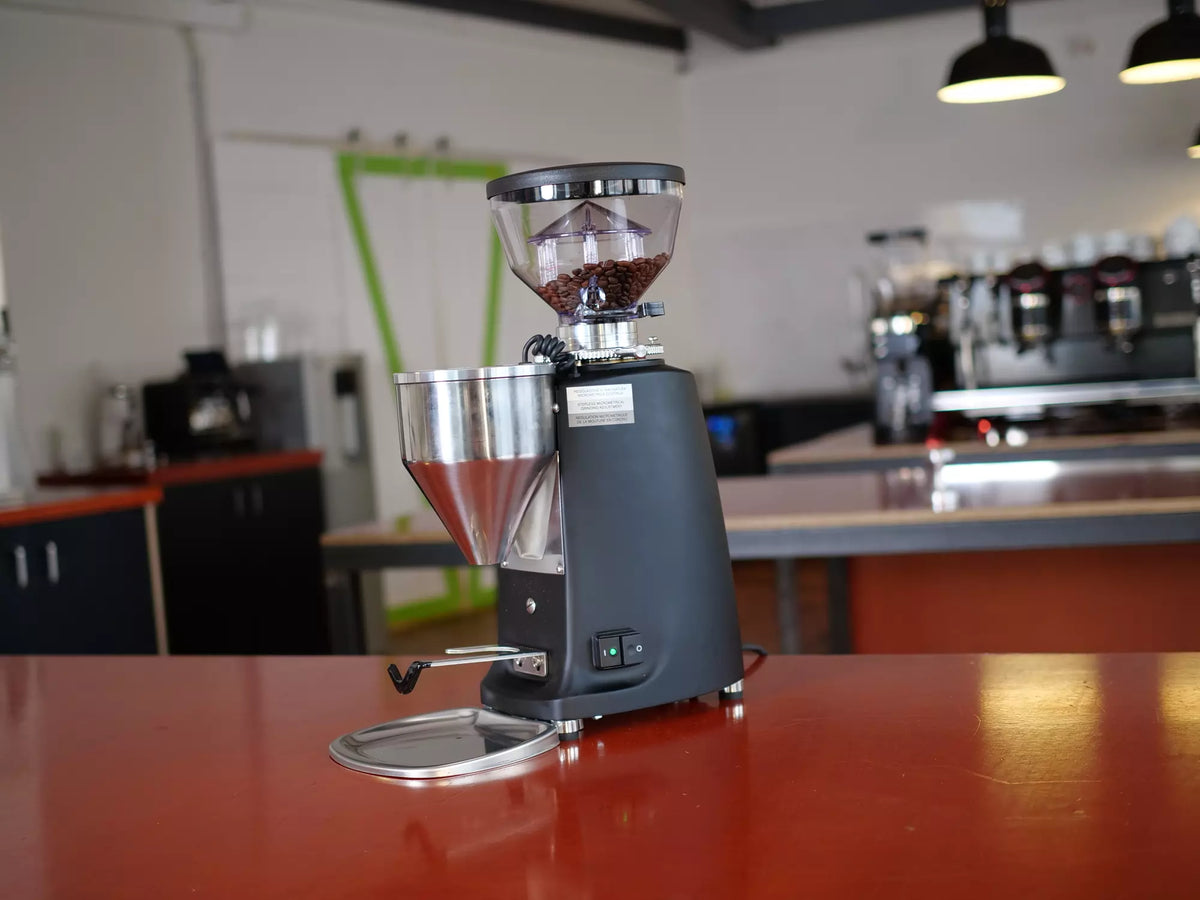

The Mazzer Mini Electronic A has been on the market as an espresso grinder for many years. And let me say upfront: it will continue to do solid work for many years to come. At a purchase price of around 750 euros/860 CHF, it is among the more expensive espresso grinders in our comparison test. How the espresso grinder performs, how it is built, and how the espresso tastes, you can find out in our espresso grinder test.
Robust, heavy, and cumbersome
The Mazzer Mini Electronic A weighs 10.2 kg. This weight is distributed over a height of 440 mm, a width of 150 mm, and a depth of 340 mm. This makes the Mazzer Mini one of the heavyweights in our test. While the robustness of the grinder is an advantage for stability, it is a disadvantage when adjusting the grind setting. The adjustment wheel is difficult to turn even with great force, despite the metal rod. When the wheel does loosen, it often turns past the desired target position.
This is frustrating. What should actually be infinitely adjustable grind settings becomes a somewhat tedious back-and-forth process. It works better by lubricating the threads - but that's not ideal. Adjusting during grinding also allows for finer adjustments. Solutions are in sight, but all of this doesn't contribute to good usability of the grinder.
The package includes a metal tray that catches the falling grounds. The Mazzer Mini scattered very little and didn't clump much in our tests. The centered funnel did good work here. The portafilter holder of the espresso grinder is exemplary - some manufacturers could learn from this. The grinder holds portafilters with spouts in both directions. Only a slight vibration of the grinder and resulting shifting of the portafilter disturbs the picture.

Usability of the grinder
The Mazzer Mini Electronic A has two programmable dosing buttons that can be programmed via a second setting. This is reasonably intuitive. However, controlling the grind setting is significantly more difficult. The reason is the difficult adjustability of the grinder described above. It is hardly possible to precisely return to the same point after adjusting. Noting or marking reference points becomes a guessing game.

The curve shows the grinding curves of the Mazzer Mini Electronic after adjusting forward and backward to the same grind position as much as possible.
Many feedback messages we received under our video test point in this direction. Many users set the grinder once and then neither change beans nor grind setting. Of course, this can also be solved that way, but it limits the ability to try different coffees. Many experienced home baristas also want to fine-tune the grind setting through gentle adjustment. This is not easily possible on the Mazzer Mini Electronic A.
This leads us to rate the grinder as "rather poor" in terms of usability.
We like the portafilter holder. Most conventional portafilters fit into the Mazzer Mini. Portafilters with a "reversed" spout, such as from Rocket, can also be placed on the holder.
During grinding, vibration occurs which moves the portafilter. However, it should be held anyway to catch the ground coffee evenly as it falls in.

Speed and noise level
The noise level of the Mazzer Mini Electronic A was in the medium range in our test. There were grinders that were significantly louder and grinders that were significantly quieter. We measured a noise level of 82.8 decibels.
In terms of speed, the Mazzer Mini was among the slowest grinders in the test field. In 10 seconds, it achieved a grinding output of 16 grams. For the desired coffee amount of 18 grams, the grinder took 11.3 seconds.
Temperature and consistency during grinding
In terms of consistency, the Mazzer Mini was among the mid-range grinders. We measured a standard deviation of 0.74 grams over 10 grindings. We put 18 grams into the grinder and checked the output coffee weight. While many samples showed results around 18 grams of coffee, some outliers were off by +1 gram from the desired amount.
| 17.0 | 17.3 | 17.9 | 17.8 | 18.4 | 18.6 | 18.3 | 17.7 | 18.8 | 19.5 |
With many smaller burrs, the coffee grounds heat up during grinding, especially when multiple shots are pulled one after another. In our test, a shot was pulled every 30 seconds. The first and last samples were also used for particle size distribution measurements. The Mazzer Mini showed only minimal temperature increase and remained at a low average temperature of 30.4 degrees. This made the Mazzer one of the coolest and best grinders in the field. Because of the temperature of the grounds, no taste change is to be expected. The particle distribution did vary, but within the range of the grinder's standard variance.
Is the Mazzer Mini suitable as a single-dose grinder?
Single dosing is in. Especially when home baristas want to switch beans frequently, the single-dosing principle is very practical. For this, the desired amount of coffee is weighed by hand in a measuring cup and fed into the grinder. The grinder should then grind these beans as completely as possible in a one-to-one ratio. In the English-speaking world, this is called "single dosing."
The most important factors to assess for this are the retention, the easy adjustability of the grind setting, and depending on your perspective, also the amount of coffee between the bean hopper lid and the burrs.
The Mazzer Mini, with its retention of 5.3 grams, has too much retention to be convincing as a single-dose grinder. These roughly 5 grams must always be ground through first - it's simply not practical. The difficult adjustment also makes it hard to precisely select the grind setting for different beans.
The coffee beans under the slider are another factor that at least makes it more difficult to switch beans in the bean hopper. 40.9 grams of coffee are located under the lid. So when we remove the bean hopper, there are still quite a lot of beans underneath. These beans must be removed before the entire coffee can be switched. All of this speaks against the Mazzer Mini as a flexible espresso grinder for single dosing and for changing coffee.
Espresso and taste
We mostly had decent espressos with the Mazzer Mini Electronic A. It impressed us more often with darker espresso roasts. The grounds were ground soft and without clumps. Taste-wise, however, we repeatedly had espressos that weren't brewed to the point.
This may also be related to the fact that the Mazzer Mini generally produces relatively many fines, but with some curves produced significantly more of the tiniest particles. These tend to over-extract and contribute to a dry, bitter cup.

This diagram shows four shots at the same grind setting. The curves fluctuate and sometimes relatively fine particles are produced. The proportion of particles under 100 microns was over 23%. In some cases it was lower, but it kept breaking out again.
At the same time, the Mazzer Mini has a relatively narrow coarse peak of 214. To determine this, the highest point of the curve is taken and then cut. Particles are considered 30% on either side of the cut. In other words, with its narrow peak, the Mazzer Mini is relatively precise at the desired grind setting, but varies more in the fine peak.
But again: the Mazzer Mini Electronic A does solid work as an espresso grinder. However, some fluctuations in consistency and the large retention minimize reliability.

The curve shows how the Mazzer Mini performs among other grinders.

About the test procedure - what was examined?
The diagram above shows all particle size distribution curves we recorded. The Mazzer Mini Electric A was listed as grinder 19 in our test.
- T1 is a measurement of the particle size distribution in the factory setting. This can vary from grinder to grinder. In this case, the Mazzer Mini was set in the ristretto range at the factory.
- T2 is a measurement of the first setting of a standard recipe of 18g coffee in, 45g espresso out in 25 seconds. Prior to this, 500g of coffee was ground through the grinder to remove residual material from manufacturing, etc.
- T3 is a check of the particle size distribution after pulling an espresso 6 times in succession every 30 seconds. The temperature of the grounds was recorded each time.
- T4 was taken after the original recipe was reset.
- T5 shows the setting of a strong, 1:1 brewed espresso/ristretto with 18g coffee in and 18g espresso out in 25 seconds.
- T6 shows the setting of a lungo coffee. 18 grams of coffee were used and an extraction of 120g in 25 seconds was achieved.
- T7 shows a curve that results when trying to achieve the same setting as in curve 4 based solely on the marking. With curve 4, the grind setting was photographed and with curve 7 we reset based on the image.
More about the protocol here.
The detailed test report will be published in the course of Wednesday, December 8, 2021.
How do the Mazzer Mini A and Mazzer Mini B differ from each other?
Internally, the Mazzer Mini A and Mazzer Mini B do not differ significantly from each other. It is mainly the exterior that differs. The control of the Mazzer Mini Electronic A is located on the centering container of the grinder. The control of the Mazzer Mini B is located below the dosing container. The burrs and other construction are the same. The Mazzer Mini B closes with a plastic lid over the centering container.
Conclusion on Mazzer Mini Electronic A
Let's start with the potential. A second metal pin for adjusting the grind setting would be a useful addition. If you don't have one, you can also use a threaded screw. It doesn't look as nice, but it works.
And with that we're right in one of the problem areas of the grinder. The adjustability, the resulting flexibility and usability. The Mazzer Mini is an established grinder and correspondingly robust and solid. With its performance, it is not recommended for top positions in our test.

Even though we had repeatedly decent and even good espressos, we also tasted some unpleasant outliers. That's why it's hard to recommend the Mazzer Mini Electronic in today's time to the knowledgeable and experimental home barista. The high price is another argument against it. The biggest pro is probably the proven longevity of the grinder, which modern and cheaper grinders still have to prove.