




Timemore offers various good hand grinders, including the Slim Plus from the Chestnut Slim series and the C2 from the Chestnut C/C2 series. The similarities are great and yet there are some differences, which we will show you in this blog post.
After the large comparison test of 14 hand grinders for coffee, we have added both grinders to our range. Simply because we really like them. You can find them in both our German and Swiss shop.
Which Timemore hand grinder is right for me?
You are faced with the decision to buy a hand grinder and have come across Timemore grinders. Why does the Slim Plus cost about €35 more than the C2? Is this price difference justified? And if so, why? Or does the Slim Plus just look a bit fancier?
We have repeatedly received questions about what exactly the differences between these two grinders are. We'll get to the bottom of this question in this blog. In addition to the Slim Plus, we looked at the white C2 and the anthracite/black C2.
The exterior of the Timemore grinders

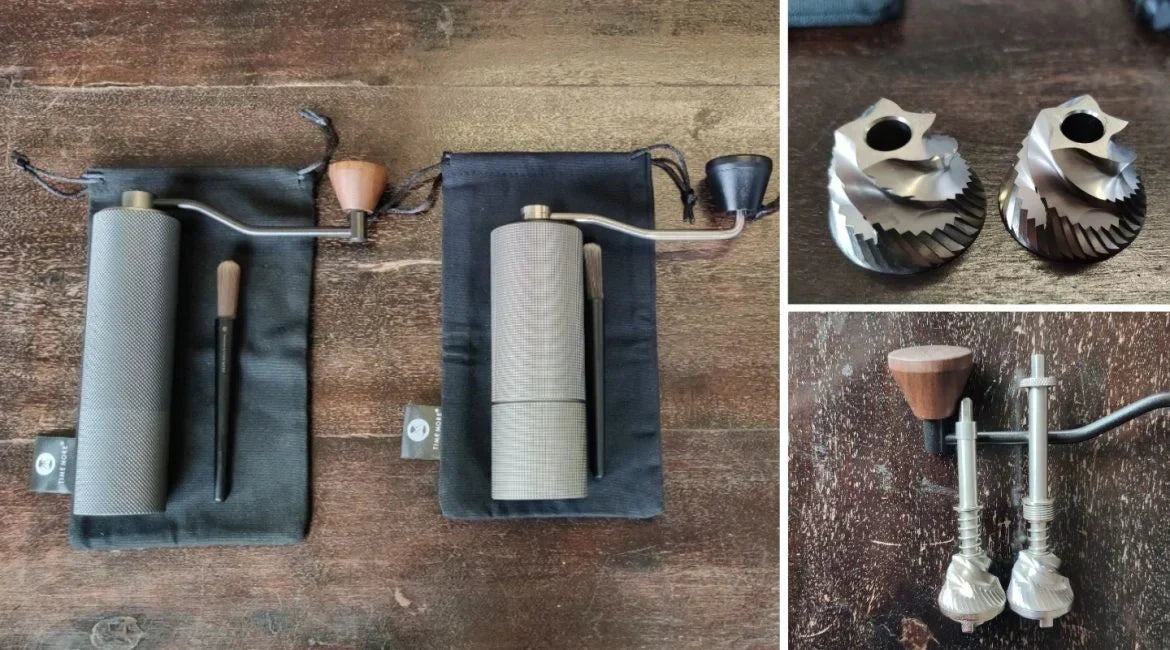
Left the Timemore Slim Plus. Center and right the Timemore C2.
The Slim Plus is taller at 17.5 cm compared to the C2, which measures only 15 cm. The body is with a diameter of only 4.4 cm much slimmer than the C2 with 5.1 cm. Another difference in the external appearance is also the haptics. Interestingly, the two C2 models also differ from each other. The white C2 grinder comes with a smooth, simple surface in a color that is better described as off-white than pure white.

Anthracite/dark gray Timemore C2.
The C2 in anthracite/black, which is actually more anthracite/dark gray in color, but is simply described as 'black' by Timemore, has a distinctly noticeable 'ribbed' square pattern on the outside.

The Slim Plus comes with a much finer pattern than the dark C2. This pattern is also pleasant to feel and lies comfortably in the hand. The most important thing about the ribbing: the Timemore C2 does not rotate during grinding, but builds up resistance through the pattern.
Another difference in the external view is noticeable when looking at the handle of the grinders. The handle of both C2 models is made of plastic. With the Slim Plus, the handle is made of wood and can also be removed. It is held by a magnet. This allows the grinder to be dismantled overall even better and, for example, stored for travel.
Accessories and packaging. Are there any differences here?
The C2 models are supplied in a flip-open package. The Slim Plus packaging appears somewhat more valuable and is comparable to a box from the smartphone sector.

Unboxing the Timemore models.
There are no relevant differences in the equipment. All grinders come with an English-Chinese instruction manual. (Tip: if you have the impression that you have a purely Chinese manual in front of you, just pay attention to the back). A nice black fabric bag is also included, which is great for travel. A brush for cleaning the grinder is also included.
The interior of the Timemore C2 and the Timemore Slim Plus
Now it gets interesting. Inside there are significant differences between the C2 and the Slim Plus.
- Structure
- The grinding mechanism and the grinding cone

Interior of the three Timemore models.
The structure
The body of the Slim Plus is made from a single piece of aluminum, whereas the body of the C2 has a plastic insert that holds the axis.


In each image on the left is the C2 and on the right is the Timemore Slim Plus. When looking at the axis, some differences immediately stand out. The axis holder of the C2 is made of plastic, the axis holder of the Slim Plus is made of aluminum.
The axis of the Slim Plus is longer, which is due to the different heights of the grinders (15 cm compared to 17.5 cm). At the top end of the Slim Plus we find an additional screw nut, which provides increased stability. In addition, the spring installed in the Slim Plus is significantly more powerful, which especially supports very fine espresso grinding settings.
The grinding mechanism and the grinding cone
Both grinding mechanisms are made of stainless steel and have 5 grinding teeth at the top end. The difference only becomes apparent upon closer inspection.
Timemore calls the grinding mechanism installed in the Slim Plus E&B, which stands for Espresso and Brewing, but what is really the difference?
The Slim Plus grinding cone is slightly larger and weighs 5 grams more than (45g vs. 50g).
As this illustration shows, the E&B grinding mechanism also has an additional blade grind in the upper area and has two more grinding teeth in the lower area than the grinding mechanism of the C2.

Conclusion for Timemore C2 and Timemore Slim Plus
The C2 is a very solid grinder with a good price-to-performance ratio, which is especially suitable for filter coffee. An espresso can also be prepared, but grinding takes significantly longer.
The Slim Plus is technically a step above the C2 due to the differences shown and from our perspective is a very good and more affordable alternative to the best hand grinders on the market.
The differences between the C2 and Slim Plus in the area of internal structure and grinding mechanism also explain why the Slim Plus grinds quite a bit faster and can also achieve even finer grinding settings than the C2.
In our view, the Slim Plus offers a very good price-to-performance ratio and is a lot of fun to use in everyday life.