


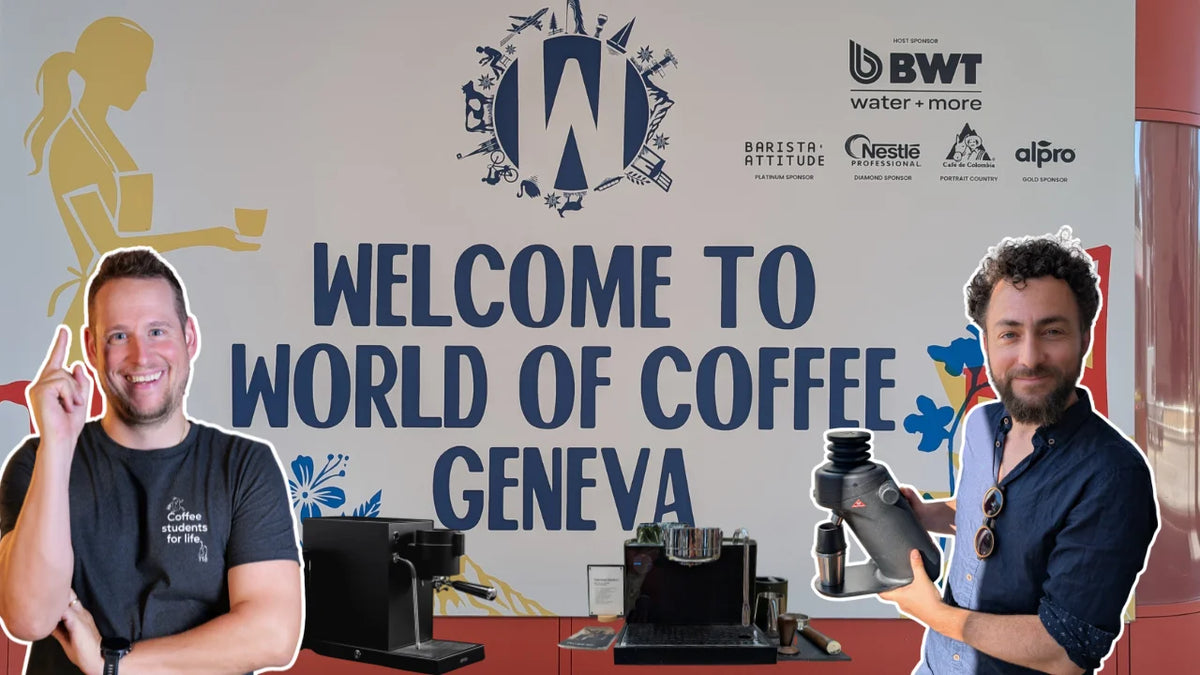

The World of Coffee 2025 in Geneva offered coffee enthusiasts a colorful fireworks display of innovations. We took a critical and curious look on site – and present to you here all the important new espresso machines and grinders for home use.
These are indeed innovations and new developments. At the same time, many manufacturers sell old wine in new bottles in their usual manner and present a new color variant of an espresso machine as a quantum leap. We skip such offerings and focus on what matters. From smart grinders to motorized lever espresso machines to portable devices – here you'll find out what's moving the industry and where the journey is heading.
As always with this trade show report: we have not tested any of the devices mentioned and can only describe a first impression. We will only be able to report how well what was announced really works in practice after a thorough test in our coffee academy.
Varia VS4 – Single Dosing Made Easy
We start with a grinder that made our espresso grinder tester Michel Indelicato positively beam at the trade show: Varia VS4, the latest offspring of the well-known Varia grinder series. This single-dose grinder closes the gap between the compact VS3 and the larger VS6. What makes it special?
- Conical burrs: The VS4 works with newly developed conical burrs (53 mm diameter) – not identical to those of the VS3, but its own design.
- Adjustable speed: For the first time, Varia offers RPM adjustment (speed adjustment) even with a smaller model to further optimize grinding speed and grind.
- Lightning-fast cleaning: The highlight is how easy it is to clean. With just a few simple steps, you can open the grinder without changing the grind setting. Michel was thrilled: Finally you can clean the burrs without having to re-calibrate afterwards!
- Anti-static: The outlet has a kind of ionizer or anti-static technology, which means hardly any coffee grounds should stick to the housing.
- Price and availability: The VS4 is expected to launch at the end of 2025, with a target price of around 450 € – a strong offer for such a grinder.
Assessment: Even the smaller VS3 was a price-to-performance hit, and the VS4 raises the bar further. For single-dose fans with a limited budget, this grinder should be very interesting. Innovative features like speed control and effortless cleaning show the trend: ease of use and maintenance-friendliness are front and center.
Update: Unfortunately, it turns out that the extremely positive first impression in our test of the Varia VS4 is not fully confirmed.

Zero:Hero – Portable Espresso Machine with Power
On my outdoor trips, I like to test portable espresso brewers. One such device is the hand espresso brewer from Zero:Hero, which won a Red Dot Award.
At the trade show booth, we tried out the small, mobile espresso maker, which bears a suspicious resemblance to a competitor's product – but makes one crucial promise: it gets hot enough!
This handy device is conceptually reminiscent of well-known portable espresso devices, but is said to heat water up to 92 °C. That's exactly where I had a criticism point with a competitor – the brewing temperature. Zero:Hero is supposed to put an end to that. I'll make a comparison and test as soon as possible.
Key Facts Zero:Hero:
- Operation: Battery-powered, usable with hot or cold water. With already hot water, up to 200 shots should be possible, from cold water about 4–5 espressos per charge.
- Brew group & handling: Fill in coffee, screw together, tamp – the ritual remains manual. The design is based on well-known examples, which immediately creates familiarity.
- Temperature: According to manufacturer specifications, the device reaches approximately 92 °C brewing water temperature. If that actually works, it would be a game-changer in this segment. Personally, I'd even go higher.
- Fun factor: Should Zero:Hero meet expectations, it's the ideal companion for espresso on the go and will soon accompany my kayak and road bike tours.
Assessment: There are many portable devices, but often they fall short on temperature or the number of possible extractions. Zero:Hero promises to solve both. We remain (cautiously) optimistic. Should the little hero actually be hot enough and enduring, it could become the reference among travel espresso makers. Price-wise we expect it in the range of similar devices (there were no concrete details on that at the trade show).

Source: meticulous
Meticulous Espresso – The Robot Lever for Home
We continued at the Meticulous booth – and here espresso tech dreams came true. Meticulous is a unique espresso machine that executes a classic manual lever shot completely mechanically - but much more dynamically controllable. We pre-ordered this beauty some time ago via crowdfunding; according to the manufacturer, the first machines are to be delivered in summer 2025.
What makes Meticulous special? Basically, you get an electronically controlled lever machine, only without a visible lever. An internal piston does the pressing, and numerous sensors monitor the extraction process in real time:
- Plenty of sensors: Built-in sensors measure flow, pressure and temperature during the shot. Nothing is left to chance – every parameter is captured.
- Single-dose water system: Before each shot, you fill a defined amount of water into a front chamber directly above the portafilter, which is then brought to precise temperature. Only the necessary water is heated.
- Integrated scale: A scale is built into the drip tray – brilliant for accurate output measurement. Simply place your cup on it, press the button, and the weight of the espresso appears on the display. Dosing and even manual single-dosing for filter coffee are thus also possible.
- Digital profile control: Pressure curves can be freely programmed and controlled. The machine can theoretically automate everything from pre-infusion to flow to pressure profiling. Profiles can be saved and recalled at any time.
- Brewing process: One button press and the piston rises in the brew head, allowing water to fully saturate the puck. Then the pressure or flow is gradually built up according to program. Flow, pressure, temperature – everything is controlled to the second. The espresso tinkerer has no limits here.
Planned price: Kickstarter supporters invested around $1,200; officially, however, the Meticulous Espresso is supposed to cost about $2,000 (without optional milk steamer). If everything works the way Meticulous promises, that's more than competitive.
Assessment: Meticulous could become the bridge between professional lever and smart machine. At the same time, the Meticulous brews directly! No tubes, no distance between brewing element and brewing chamber. The heating and pressure generation moment takes place at the brewing chamber or at the portafilter. There are still many more strengths and few weaknesses that Meticulous will likely have. We're looking forward to our model more than almost any machine before.
Muvna Switch-Grinder – Two Grinders in One
At trade shows you see all sorts of things – but this innovation amazed even us: A manufacturer showed an espresso grinder where you can change the complete burrs within seconds. Yes, you read that right: Conical or flat? You no longer have to decide, you just switch!
The grinder – announced in the European region under the name Muvna – features two interchangeable burr sets: a massive 98 mm conical burr set and a flat set with 83 mm discs. Using a lever, you remove the entire front section, which is held to the main body of the grinder via metal pins. Then the other burr set is simply attached. The "burr change" is done in 3–4 seconds.
Further facts about Muvna:
- Retention minimized: Due to the design of the interchangeable system, apparently virtually no coffee grounds remain stuck in the grinder. Less retention = less old coffee in the next shot.
- Target audience: High-end home users and lab technicians? Just kidding – Muvna targets hardcore geeks who want to choose the optimal burr type depending on the bean (conical for more traditional espressos, flat for light roasts for example). Or for the indecisive who simply want both or want to experiment.
- Performance: Concrete technical details (motor, revolutions, etc.) were not mentioned on site. But the burr sizes alone show: we're playing in the top league here.
- Price & availability: The Muvna grinder is expected to be market-ready around August 2025. A price of around $3,000 was hinted at – so certainly not a bargain.
Assessment: Muvna takes a radically innovative approach. Whether you really constantly switch between conical and flat in everyday use is debatable – but as a technology demo alone it's impressive. For well-heeled espresso nerds, Muvna could be the all-in-one solution. Retention, flexibility and engineering excellence were clearly front and center. We're really curious to see how this grinder performs in testing and whether the switching mechanism is durable in the long term. Definitely one of the most exotic highlights of the WOC in Geneva 2025.

WPM Primus – Pro Features in Compact Format
WPM is long past being an insider tip when it comes to affordable espresso machines. In Geneva, the Hong Kong-based company delivered twice: with the new Primus espresso machine and exciting updates to their grinders.
Primus: Dual Boiler, Thermoblock & Pressure Profiling
The WPM Primus looks like a typical 1-group home machine at first glance, but inside it's pure high-tech. It's aimed at ambitious home baristas and small cafes. What makes it special?
- Innovative heating system: The Primus combines a classic 0.8l boiler with PID control for espresso with two thermoblocks – one for hot water and one ("supersteam thermoblock") for steam. Result: rapid heat-up time and strong temperature stability despite compact design. In fact, according to the manufacturer, the machine is ready to use in about 2 minutes – impressive if that works. Though many have claimed it and few have delivered. We'll see.
- Gear pump with profiling: Instead of the usual vibration or rotary pump, WPM uses a quiet gear pump. This allows precise pressure profile control: You can adjust the pressure curve during the shot or even (in the future) control flow. Multi-stage profiles with programmable phases are already possible – from pre-infusion to pressure ramp-down.
- Built-in sensors: The machine also has a flow meter and according to manufacturer information in the hot water area. This is truly extraordinary in this price range. Plus a fairly intuitive LED display that shows all parameters.
- Plenty of steam: The dedicated steam thermoblock delivers dry steam with plenty of power – fine-pored microfoam for latte art is achievable. How achievable, the developer showed us directly on the machine. It was the most beautiful latte art I've ever seen a technician make. The steam boiler only runs when you need it, which saves energy.
- Tank & Mains water: WPM supplies both a water tank and mains water connection from the factory – at no extra cost, at a targeted price of around 2,000 €. Many other manufacturers charge a lot for the mains water option; here it's standard.
Assessment: The Primus combines many trends in one machine: fast-heat-up technology, pressure profiles or step control, and energy efficiency. That WPM offers this for ~2,000 € is quite a statement. Of course, we need to check how the hybrid approach (boiler + thermoblock) works in practice and whether the machine can really deliver the heat-up time and temperature stability. But what WPM is showing here is very very promising.
WPM ZP-1 and KONOS: Single-Dosers in Double Pack
In addition to the machine, WPM also showed new things with the grinders. Already known is the WPM ZP-1, a compact single-dosing grinder that debuted at the last Frankfurt Coffee Fair. In Geneva, the surprise: KONOS, a new conical grinder based on the ZP-1.
WPM ZP-1 – the flat burr single-doser:
64 mm flat burrs, adjustable RPM and very low retention. Praised for its solid construction. (We haven't tested it ourselves yet, but we have an order in to catch up.)
- Single dose conical: KONOS features a conical 71 mm burr set.
- Adjustable speed: Like the ZP-1, KONOS also offers an adjustable burr RPM to control grind and speed.
- Easy-clean mechanism: Inspired by the ZP-1, KONOS features a quick-clean mechanism for the burr unit. Removing coffee grounds residue should be a breeze – important for single-dosing.
- Design & quality: Aluminum housing, modern look.
Assessment: With ZP-1 and KONOS, WPM has two arrows in its quiver to shake up the single-dose market. The strategy is a bit reminiscent of Niche (which also offers flat vs. conical options with Zero and Duo). What's exciting is the combination of speed control and cleaning comfort. In short: WPM is hitting the gas to appeal to ambitious home users. We're already looking forward to taking a thorough look at both grinders!

Fellow Espresso Series 1 – High-Tech in a Plastic Shell
The manufacturer Fellow, known for stylish water kettles and accessories, is now stepping onto the espresso stage. At the Fellow booth, the brand new Espresso Series 1 was presented, Fellow's first portafilter machine. Here are the key impressions:
Technology & Features:
- Three heating elements: The Series 1 uses a thick film heater + mini boiler + brew group heating in combination. Specifically: A pre-heater rapidly heats water and feeds a small boiler, which in turn supplies the brew group, which also has a heating element. That gives triple water tempering along the way. This should make the machine heat up quickly and maintain temperature very stably – ambitious!
- Full profile control: Remarkable for a machine of this class: You can program pressure profiles. Pre-infusion and pressure ramping – all of this should be possible and easily adjustable via dial/display. Plus there's a profile save function, so you can save recipes for different beans (including temperature, pressure and flow during the shot).
- Quick steamer with a catch: The Series 1 is dual-use (espresso & milk), but technically behaves more like a single boiler when switching to steam. To froth, the mini boiler needs to be heated up, which takes a moment, and then cooled back down for espresso. Fellow emphasizes that they've implemented smart solutions – how well that works (and how quickly they cool the temperature back down) needs testing. Additionally, there's an assisted steaming function: The machine offers pre-selected steam temperatures for different milk types (e.g., less heat for oat milk).
- Operation & aesthetics: The device has a modern, sleek design (available in black, red, brown) and reminded us of some existing machines in terms of form factor – though aesthetics are in the eye of the beholder. Operation is via a turn-push wheel and a display. Everything should be very intuitive. In practice, we couldn't get out of some menus without further ado - but you'll get used to it.
- Price & material: Here it gets interesting: The price is around 1,500–1,600 € (Fellow USA gives $1,499 MSRP, early birds paid $1,399). That's extremely competitive considering the features – but it's only possible through generous use of plastic for the housing. The machine is almost entirely made of robust plastic, with metal found only in a few places. That keeps costs down, but raises questions about durability and longevity.
Assessment: Fellow has taken a bold step with the Espresso Series 1. On paper, it combines features you'd expect from more expensive machines in a sleek, compact device at mid-range price. If the concept works, Fellow could score a real price-to-performance hit and challenge incumbents like the Lelit Bianca. However, skepticism is warranted: How well does the temperature control work with the small boiler? How long will the plastic housing hold up to daily use? Critically, but curious, we're waiting for a test unit. Because if the Series 1 delivers on its promises, many home baristas might soon be "pulling shots with saved profiles" – without spending a fortune. Innovative, but please also solid – that will be the key.
ECM & Profitec News – Exacto Grinder and More
At the joint stand of ECM / Profitec, we found two highlights: a new single-dosing grinder called Profitec Twist SD54 (already tested by us) and the prototype of the ECM Exacto, a grind-by-weight grinder.
ECM Exacto – Grind-by-Weight with Brains
The ECM Exacto is set to appear at the end of 2025 and marks ECM's entry into precision grinding. Its name says it all. Here are the key facts we found out:
- Direct dosing by weight: The Exacto features an integrated scale that weighs the dispensed grind in real time and automatically stops the grinding process once the target dosage is reached.
- 64 mm burrs are used.
- Stepless adjustment with digital display: Grind adjustment is stepless via dial, but with a digital scale in the display. That is, as you change the grind setting, a display shows the numeric value with high resolution.
- Portafilter detection: The grinder automatically recognizes whether a single or double basket is installed. It could then suggest different standard dosages. That's ahead of all other weighing grinders under 1500 euros.
- Development stage: The prototype at the show felt good already, but needed some fine-tuning. ECM wants to show an improved version by the HOST fair in the fall and then quickly get to market. Optically the grinder is somewhat larger than previous ECM grinders – little wonder, it has significantly more technology inside.
Assessment: With the Exacto, ECM is entering a trend that brands like Baratza and Eureka have already picked up: smart scales with weighing technology. For ECM fans who value German craftsmanship and sleek design, the Exacto could be a great complement to an ECM portafilter machine.
Price-wise there's been no information yet, but the grinder will likely cost more than 1000 euros. If accuracy and reliability are right, the Exacto will certainly find customers – "beautifully fine grinding result" is what Michel had already attested to in the trade show shot. We'll stay on it and hope to report more soon and be able to test particle distribution.

The DACH Arkel Connection was also at the trade show. Lukas Brenneis from Brewspire, Markus Berger from Vitudurum (Switzerland) and Wolfgang Köppl from Die Röster (Austria) closely accompanied Fernando Moreira from Arkel in the development of the new Arkel Coast Dual Boiler. The machine wasn't at the trade show. But a unit arrived at our place today and will be tested soon.
Sage/Breville Oracle Dual Boiler – When the Machine Adjusts the Grind Setting
Sage Appliances (in Germany under "Sage", globally known as Breville) took another step forward in integration at their compact machine trade show 2025: Espresso machine and grinder merge into an intelligent system. Specifically, we got a preview at the Sage booth of the next generation of the Oracle line and dual boiler machines. And they were impressive.
What's new at Sage? In short: the Sage Oracle Dualboiler with more user control and automatic re-adjustment by the machine. In detail:
- Fine-tuning all parameters: The new models offer far more adjustment options than before. Grind mode selectable (by time or amount) – even with integrated grinder. Pre-infusion can be time-controlled (with constant low pressure, ~1–2 bar), similar to a "blooming" phase. Overall, the machines seem much more open to the user, whereas previously many things were preset and limited.
- Integrated grinder with auto-adjust: The combo machine Sage Oracle Dualboiler monitors extraction and automatically adjusts the grind setting. If the shot runs through too fast, the machine makes the grinder finer; if it runs too slow, it goes coarser – all by itself. This feature has only been known from gastronomy so far, such as from self-regulating grinders in large super-automatics or the Mahlkönig grind-by-weight plus sync system in networked form. Sage now brings that into the home.
- Connectivity: The machines feature smart functions like remote power-on capability. Via app you can preheat the machine, say from bed. Cozy!
- No turbo heater, instead parallel operation: Sage consciously decided against a pure thick film heater/thermojet to enable simultaneous espresso extraction and milk frothing. The new dual boilers heat up in roughly 10–15 minutes, which is somewhat mitigated by remote start.
Assessment: Sage/Breville is taking a big step toward "machine learning" in the espresso kitchen. The grinder responds if the espresso runs too fast or slow. Since the Sage Oracle Dualboiler also relies on its own automatic tamping, the machine now controls the entire process.
For entering the espresso world, that could be invaluable: Fewer failed attempts, more consistency. Experienced users might turn up their nose ("I'll adjust it myself!"), but they also benefit from expanded control capabilities (pre-infusion etc.). The question is what all this will cost.
The networking topic (keyword: machine "communicates" with grinder) is striking here. Sage set the precedent – and as we heard, other manufacturers are working on it too (Rocket is experimenting with a Bentwood grinder in synergy at the gastro level). Conclusion: the gap between super-automatic and portafilter is getting shorter as more smart mechanisms ease espresso preparation and company.

Baratza Encore ESP Pro – Espresso Entry 2.0
One of the most delightful news on the grinder front was the Baratza Encore ESP Pro. Baratza is known for home grinders (Encore, Virtuoso, Sette…), but now they've souped up their entry-level Encore model significantly. The Encore ESP Pro was unveiled at the Houston Expo and was also at the center of their booth in Geneva.
What Does the Encore ESP Pro Offer?
- Stepless & fine: Unlike the classic Encore with coarse clicks, the Pro version has a stepless burr set with ultra-fine resolution of 2.2 micrometers per step in the espresso range. This allows precise dial-in for portafilters, but it also continues to cover a wide range up to filter coffee (the burr set has two zones: espresso and brew).
- Digital display & timer: For the first time, Baratza is installing a proper display. This not only shows grinding time in 0.1-second increments but also the grind setting as a number! Turn the hopper and the display switches from timer display to numeric grind setting – a great aid for reproducing settings. We were impressed by how precise and repeatable it seemed.
- Auto-off for single dosing: The grinder has two operating modes: timer mode (classic for hopper operation) and single-dose mode with auto-stop. In SD mode, the grinder senses when no more beans are in the burrs and shuts off. No more running empty – practical! For single-dosers, a small air blower can also be attached to blow out the last crumb – though Baratza has another innovation ready here…
- Integrated ionizer: Yes, you read that right – Baratza has equipped the Encore ESP Pro with an ionizer for static removal. A small plasma generator module creates ions that neutralize the static charge on the grind. Result: Hardly any more static charge and sticking in the outlet. Baratza has essentially brought major anti-static technology to the entry-level segment. Hats off!
- Further details: LED lighting in the outlet chute (so you can see what you're doing), improved interior materials (more metal parts for stabilization), and an easily replaceable bean hopper (you can switch between single-dose hopper and a small attachment for continuous operation). Oh, and best of all: according to their claim virtually no retention – we'll check ourselves and measure it ourselves.
- Price & market launch: The Encore ESP Pro will be surprisingly affordable at $300 (around 299 €). It will gradually replace the old Virtuoso line and form the new entry-level duo at Baratza alongside the existing Encore ESP (non-Pro). Market launch is targeted for fall 2025.
Assessment: This might be the new reference under 300 €. Baratza combines in the Encore ESP Pro much of what you previously only saw in more expensive grinders: stepless fine adjustment, timer & display, anti-static. For espresso beginners in particular, the new Baratza should be extremely attractive.
Eureka Mignon Specialità Smart – When the Grinder Thinks Along
Italian grinder manufacturer Eureka has given its bestseller, the Mignon Specialità, a brain upgrade. The new model is called Specialità Smart and brings a patented "smart technology" that's especially designed to guide beginners.
What Can the Smart-Specialità Do?
- Burr-distance display: The grinder features a digital screen that displays the burr spacing in real time. As you adjust the grind setting, you immediately see the change in micrometers on the display while the burrs move. No more guesswork about where you stand – you can't get more precise than that.
- Extraction time assistant: Here's where it gets really clever: You can enter your target extraction time into the grinder (e.g., 25 seconds for an espresso) and then the actual runtime of your last shot. The grinder then calculates a grind setting suggestion – concretely it says something like: "Go from setting 195 to 200, so coarser, to reach your target". The whole thing also works with saved recipes (dosing, output, time): you can save recipes (multiple profiles, for example for different beans) and then get a grind setting hint depending on which recipe you choose, to get back to where you were.
- Recipes & memory: Up to 12 recipes can be saved, including target input weight, output amount and extraction time. If you switch beans and load a saved recipe, the grinder shows: "For 18 g in, 36 g out in 30 seconds set from 201 to 175." Something like that – very helpful to quickly find the right spot you determined at some point.
- High-precision construction: Eureka has apparently also optimized mechanically to ensure repeatability. Plus they announced extending the motor warranty to 10 years – a vote of confidence in durability.
- Price: The Specialità Smart costs about 600 € and will be available from June/July 2025 onwards.
Assessment: Eureka is taking a similar path to Sage and Co., but from the grinder's perspective. The grinder "coaches" the user to the right grind setting – something we hadn't seen in grinders before that.
Exactly what smart machines already do (e.g., the new Sage) – giving users tips ("go finer/coarser") – Eureka now does standalone in the grinder. The industry trend is clear: devices should support beginners and flatten the learning curve. For pros it might just be a nice gimmick, but for beginners such a digital assistant can save frustration.
It's obvious that Eureka is also thinking about connectivity: Today the grinder reads the time from the user – tomorrow maybe directly from the machine? Just a small step until machine and grinder exchange data directly and react automatically. That's not happening yet, but we can well imagine a future Eureka picking up info from an espresso machine with an open interface and adjusting itself automatically.
Conclusion: The Mignon Specialità Smart is an exciting bridge from classic grinder to the smart era. And even without connectivity, it's simply a top grinder with modern operating concept – innovative and user-friendly for beginners and newcomers.
Gilda Dual Boiler – Swiss Turbo Machine with Volume Doser
Just before the end of the trade show we ran into Bruno Trepp from Kaffeewelt GmbH again, a Swiss barista and entrepreneurial institution. Bruno stood with us on stage at barista championships over a decade ago. The busy "Kafimaa", as he's been calling himself for years, took over the Swiss espresso machine manufacturer Gilda last winter. It was founded by Marco and Dorothea Tschümperlin in 2012.
Bruno wants to help his team give the already innovative machine greater reach. Here's some info on the dual boiler machine:
- 2 minute heat-up time: Yes, dual boiler, but thanks to tiny coffee boiler (120 ml) and four heating cartridges with a combined 1600 watts, the machine is ready in 2:00 minutes! (The portafilter still needs about ~6 minutes to catch up, or by running water through it.) That's record time in the dual boiler segment, but needs thorough testing in our lab before confirmation.
- Eco-steaming on demand: The steam boiler stays off until you need it – then it heats to steam readiness in 40 seconds. That saves tons of electricity.
- To go with the Gilda espresso machine there's also a grinder, with unique volumetric dosing: The bean hopper has two chambers (for single and double portions); you fill beans in there, flip it over and the volume corresponds fairly precisely to the needed dose.
- A built-in flow meter in the machine ensures the right amount of water is used for the shot.
Assessment: This project shows what's possible in energy saving and speed without sacrificing dual boiler comfort (simultaneous operation). With a price of 3,995 Swiss francs, the machine made in the Swiss factory is quite substantial.

Mahlkönig X64 SD – Big Player Embraces Single Dose
A real treat to finish: Mahlkönig – the epitome of German coffee grinder quality – is now also jumping on the single-dosing bandwagon. X64 SD looks interesting and stands out especially with a very competitive price of 499 euros. That's only possible, however, because Mahlkönig is for the first time also manufacturing with its core brand in China. So that's where virtually all grinders in the same price range come from these days. The key question will be: can they maintain Mahlkönig quality in long-distance manufacturing? The initial impressions of the grinder I gathered in Geneva are promising in any case:
- Flat 64 mm burrs
- Flexible use: The X64 SD can be used classically as a single dosing grinder with air blower or with a small bean hopper. Since it doesn't have a timer, that makes less sense. Three different attachments are supplied. That's nicely versatile.
- Magnetic dosing cup: The included dosing cup snaps magnetically into the holder. The cup itself can be extended upward to reliably catch coarser grind with a tendency toward static charge.
- Easy cleaning: The entire discharge unit can be removed with one hand and brushed out. Access to the burrs requires loosening three screws.
- Price & availability: Mahlkönig is targeting a price under 499 €, which sounds quite attractive for a premium brand. Market launch is expected very soon.
Assessment: Mahlkönig officially enters the single-dosing game for home espresso machines. Unofficially they've already started. The EK43, with Matt Perger, paved the way for this trend. For the EK43 though, you still shell out more than 2,300 euros today.
Between the EK43's rise to favorite grinder of many baristas and 2025, more than three dozen single-dosing grinders from other manufacturers hit the market. For the home segment Niche paved the way.
10 years later, Mahlkönig is now responding with its own variant and doing so very competitively right away. The first impression of the Mahlkönig x64 single dose is positive. The price is enticing. We're already looking forward to testing our unit thoroughly in the coming weeks and months.
The Mahlkönig X64 SD will be available from recommended retailers like Stoll Espresso .
Industry Trends: Intelligence, Connectivity and Comfort
After this tour through the new products, it's worth taking a look at the big picture. What trends are emerging in the home espresso industry in 2025?
- Smart helpers & automation: Whether Sage's self-adjusting grinder in the Sage Oracle Dualboiler or Eureka's grind-setting-advising Specialità – devices are thinking more and more. The goal is to support the user, avoid mistakes and simplify the perfecting process. Espresso machines and grinders synchronize or at least give clear hints. Beginners especially benefit from shorter learning curve. The barista is not replaced, but guided.
- Networking and communication: First steps toward machine-to-machine communication are visible. Today the combo machine corrects its own grind setting, tomorrow maybe the portafilter machine radios to the external grinder: "Shot ran too fast – grind finer!" Rocket Espresso showed something like that at the gastro level (connection machine ↔ Bentwood grinder). Hemro (Mahlkönig) recently acquired German machine brand Xenia – likely to drive such integrations forward. In coming years we'll see increasingly networked ecosystems where machine and grinder work harmoniously together. This brings the systems we know from Dalla Corte and Mahlkönig in gastro into the home segment as well.
- Sensors and data logging: The Meticulous impressively shows how sensors (pressure, flow, temperature, weight) let us pour every shot into data. Such data will be used even more in the future to create profiles, make auto-corrections or simply give users feedback. Scales in machines (see Meticulous) or IoT modules will become more common. Tomorrow's home barista might have more graphs on the tablet than yesterday's roaster had. 😉
- Speed and energy efficiency: Nobody wants to wait 30 minutes for heat-up anymore. Thick E61 brew groups are under pressure from new technologies. Whether Fellow's three-heating-element system, WPM's boiler + thermoblock combo, or Gilda's 2-minute boiler – fast and hot is the motto. At the same time, manufacturers are watching energy savings: Turn thermoblocks on only when needed; insulate small boilers; standby modes and app-controlled startup. The ecological footprint of the home espresso oasis should shrink without sacrificing comfort.
- Single dosing and low retention: With grinders, the trend clearly continues toward single-dose concepts. Reasons: less retention, easier bean switching, flexible grind settings. At the same time, we see innovation in anti-static (ionizers, coatings) and cleaning (tool-free opening, replaceable burrs). Manufacturers have figured out that high-quality coffees only show their complexity when home baristas can easily clean their grinders.
Finally, worth noting: The World of Coffee 2025 in Geneva was an intense ride. We spent three days talking to many manufacturers and gathering information for you.
The industry is becoming ever more diverse, intelligent, and at the same time user-focused. Sure, we coffee people also love the analog, the manual – but who says a few clever chips and motors can't make our lives easier? As long as the coffee turns out better as a result, innovations are welcome. And there were some this year. However, many manufacturers have saved their new products for the Host in Milan, which will take place at the end of October. We'll of course be there to check it out and report back.
That said: We're looking forward to numerous tests with appropriate depth as soon as all these exciting machines and grinders arrive at our place. As always, we'll keep you updated with videos and articles. The home barista world keeps moving – and we're staying on top of it for you, critically, curiously, and with lots of fun. Until then: Take care of yourselves and drink good coffee!