


Nivona Cube 4102 in the test: The fully automatic machine where you distribute yourself

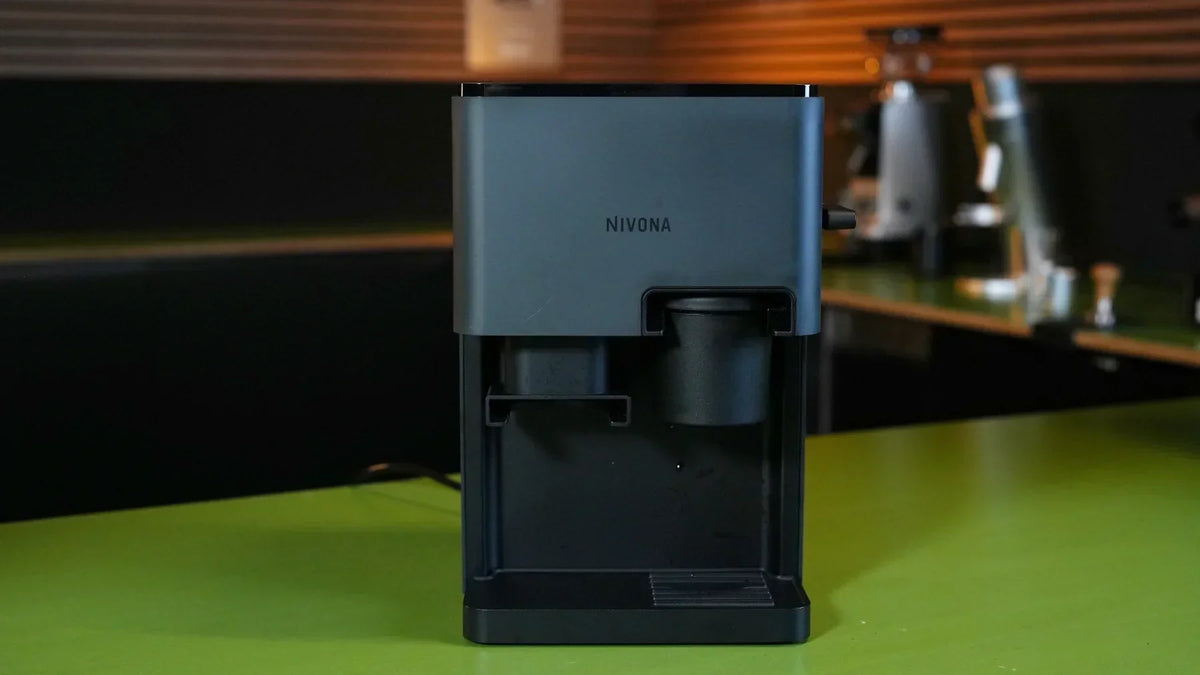
The Nivona Cube is a fully automatic Kaffeemacher that has picked up a few things from the portafilter. The most important of these: you see the ground coffee before brewing and can distribute it yourself. This takes away the core weakness that conventional fully automatic machines regularly fail on. Nivona is asking 479 euros MSRP, but the machine is typically found in stores for around 430 euros and in Switzerland for about 500 francs. We tested it according to our KM protocol, including particle distribution, which we measured together with ZHAW in Zurich. The central question: Is evenly distributing the puck enough to get really good coffee from a fully automatic machine?
The Principle: Basket Out, Coffee Distributed, Basket In
Instead of a permanently built-in brew group with a piston, the Cube has a removable brew basket, which Nivona calls the Click Cup. Michel Indelicato, vice barista champion on our team, quickly settled on "basket," and that's what we're sticking with. You clamp this basket into the front of the grinder, and the machine recognizes it immediately, displaying only what you need at that moment in the display: the grind amount. A press on the bean symbol, and the hardened steel conical burr gets going.
For 12 grams, the Cube grinds for eight seconds, which remains pleasant in everyday use. The distribution in the basket is already solidly good right out of the box, and this is where you come in. A quick tap, a gentle shake, and the landscape of hills is gone. This manual step would be a quality leap in any other fully automatic machine, because there the piston presses on an uneven coffee bed, through which water then finds its way. This is exactly how channeling occurs, and this is exactly what leads to those hollow beverages that taste simultaneously bitter and sour. Here the Nivona Cube is more similar to a classic portafilter machine than any other fully automatic coffee maker.
Tamping happens automatically as soon as you push the basket into the brewing position. The piston goes deeper with less coffee than with more, and the result is a cleanly compressed puck without holes. After brewing, you turn the basket once and the coffee puck comes out the top, letting you knock it into a knock box. Then wipe it out with a cloth—preferably a black one, so you don't see the coffee particles on it. The basket cannot go in the dishwasher.
The Grinder Is the Bottleneck: Main Peak at 367 Micrometers
When we test a grinder for espresso, our target range is between 200 and 300 micrometers, and really good grinders can go even lower. Beyond 300 micrometers, the result becomes so scattered that even distribution and extraction barely succeed. The Cube has an X50 of 347.9 micrometers, the main peak sits at 367 micrometers, and the fine peak is at 31.1. This is more of a coffee cream distribution than an espresso distribution.

We additionally tested the grinder on our reference espresso machine, using the same sieves and test procedure as we do for all other grinders. Even on the finest setting, we couldn't reach a range where we could pull a classic espresso with 25 seconds of extraction time. This isn't solely due to the quality of the burr set, but simply because the grinder cannot grind fine enough. Conversely: if you fill in finely ground coffee by hand, you'll get nothing out of the Cube. We tested this with various coffees.
The remaining grinder values are decent. At 76.5 decibels, the Cube stays below our 80 decibel threshold and is in the quiet range. The ground coffee comes out of the grinder at just under 28 degrees, which is also a good value. For dosing consistency, we measure a standard deviation of 0.47 grams over five portions, with outliers between 11.2 and 12.5 grams. That's middling, but it matters little in this concept, since you can see the amount in the basket anyway.
Retention: 13.6 Grams Is More Than an Entire Portion
The retention is the coffee that remains in the grinder after grinding. For the Cube, we measure 13.6 grams absolute, with about 3 grams in the front area and the rest in the grind tunnel. To put it in perspective: one portion is 12 grams. The residue is therefore larger than what you actually brew, and this is a clear no-go.
In everyday use, this means: your first coffee in the morning is brewed with yesterday's ground coffee. Consequently, you have to throw this out if you want good coffee.
The difference is noticeable, both for espresso and lungo. The first brew from a cold basket simply doesn't taste good.
Crema Valve: Pressure Comes From the Valve, Not From the Grind
Like almost all household fully automatic machines, the Cube works with a crema valve. The brew chamber remains closed until, depending on the machine, a pressure of two to four bar is reached, then the valve opens and the coffee shoots into the cup. The purpose: because the grind sizes in fully automatic grinders are usually too coarse, otherwise no pressure would build up at all. The valve creates it artificially and also delivers the thick crema, to which it owes its marketing name.
Technically, this is nothing other than the principle of a double-walled basket, and that has consequences. You get crema even from old coffee, you can't see the flow, and therefore can't calibrate the grind. The machine doesn't even ask you to. Without a crema valve, the espresso would simply rush into the cup at this grind size.
Temperature: Why We Don't Provide Absolute Values Here
For espresso machines, we clamp a Scace portafilter into place for temperature measurement, which simulates real brew pressure. Such a measuring portafilter won't fit into the Cube. Michel instead placed a temperature probe directly under the shower head, narrow enough that brewing could still continue. The only resistance in the system was the crema valve, and that's simply not the same back pressure we're otherwise used to.
Under these conditions, we measure around 85 degrees at the highest of the three temperature levels. With real resistance, we probably would have ended up at around 88 degrees. Because that remains an estimate, we deliberately forgo absolute values on this machine and forgo an assessment according to our temperature protocol. As an orientation, it's enough though, because 85 to 88 degrees are rather on the low end for a fully automatic machine.
This leads to a clear practical recommendation: for most coffees, use the hottest of the three brew temperatures; only with very dark roasts can you go down one level. We consistently got the best results this way sensorially. The thermoblock, by the way, needs a moment to heat up before the first shot starts.
Prebrewing: One Third Wetted, That Accomplishes Nothing
The Cube does a prebrewing before every shot, and you can't turn it off. We checked what it actually does by stopping the brew after the prewetting and removing the basket. The result: not even a third of the coffee was wet.
The purpose of prewetting is to wet the entire coffee so it won't resist water when the main flow comes, because then everything extracts evenly. If only a third is wetted, that doesn't work. Almost all manufacturers do it this way, but it's wrong nonetheless.
Espresso: 12 Grams In, Around 30 Grams Out, About 6% TDS
If you want to drink espresso with the Cube, you can, with this recipe: finest grind, highest grind amount, and smallest shot volume.
The TDS, the amount of dissolved solids relative to water, is around 6 percent. For comparison: filter coffee is 1.2 to 1.4 percent, properly brewed coffee cream is between 1.5 and 2.5, and espresso starts at around 6 percent. By definition, that's an espresso.
Sensorially, it's fundamentally solid and ranks among the better espressos we've had from a fully automatic machine. However, it reminds us strongly of an espresso from a DeLonghi Dedica with a double-walled basket and a weak grinder. The beverage ended up where an espresso belongs, but the limitations remain visible. They're called crema valve, temperature, and above all grinder.
The Signature Strength Is the Full-Bodied Lungo
The Cube gets interesting with anything longer than an espresso. Shot volumes are graduated in four levels and are around 30, 50, 70, and 110 milliliters. We recommend the third level.
For this, the machine needs at least 30 seconds of brew time, which is quite a lot, but leads to a very good result. The fourth level at 110 milliliters is clearly too much and tastes over-extracted.
With the grind level at the third of five settings, the Constant profile, and the highest temperature, a beverage lands in your cup that's more like a long espresso than a classic coffee cream: cocoa, sweetness, a full body, and a nice bitterness that doesn't turn harsh. Most importantly, the coffee tastes clean, and that's because you have the brew chamber in your own hands and can keep it clean. For us, this is the best long coffee we've had from a fully automatic machine in a long time.
If you drink a large mug in the morning, make two brews back-to-back instead. So grind and brew twice, 24 grams of coffee total and around 140 milliliters in the cup. Then the pot actually tastes like something.
Brew Profiles: Constant Wins
Nivona calls the three brew profiles Aroma Balance System and shows pressure or flow curves for them on the website. We can't confirm that because we can't measure pressure without a measuring portafilter. We can assess brew time and sensory results.
Dynamic reduces flow after prebrewing briefly and then goes back up quickly. At the espresso level, this became metallic and unpleasantly bitter, at least in combination with our Compadre.
Constant pulls pressure buildup more slowly and longer. That's sensorially reminiscent of a portafilter machine with a vibratory pump and has delivered the most balanced results with various coffees. That's our recommendation.
Intense lengthens extraction time easily by five to eight seconds. For a lungo, that makes little sense, because we prefer to get longer extraction through a finer grind rather than a heavily throttled pump. As an experimental field for lighter roasts, you can still try it.
If you compare the profiles yourself, do two brews with the same grind level back-to-back, and make sure everything is preheated and the retention is empty. Otherwise you're comparing different factors.
What's Annoying in Everyday Use
There's no milk frothing system—you should know that. The drip tray is the smallest we've ever encountered, and the distance to the outlet height is a good ten centimeters, which works for classic cups but not for large mugs. Beans regularly get stuck in the plastic grating of the bean hopper.
On our test units, we also noticed that the brew group is open at the bottom and the first brew wasn't cleanly sealed, with odd residual drops after the shot. We occasionally had explosive brews. And after several shots in a row, the water in the tank was around 40 degrees. Finally, a small thing that helps in everyday use: wait a moment after the shot until the machine has depressurized before you lift the lever and remove the basket.
Who Should Consider the Cube?
If you exclusively drink espresso at home, we'd recommend something else in this price range. A DeLonghi Dedica for 150 to 200 euros, a single-walled basket, and a grinder like the DF54 for around 250 euros comes in at roughly 450 euros and delivers better espresso. A Gaggia Classic, at least used, or a Lelit Anita are also in this range. Such a separate setup doesn't need much more space than the Cube, by the way. Which design suits you, we've written about in our espresso machine buying guide.
Why we mostly advise against portafilter machines with built-in grinders in this price range, we've detailed separately, and the Cube shows the reason pretty clearly: the built-in grinder is where it gets stuck. If you buy a separate grinder, you can replace and upgrade it individually later without swapping out the whole machine.
The Cube gets interesting, however, in a mixed household where sometimes a short drink and sometimes a longer one is desired, and nobody wants to deal with the innards of a classic fully automatic machine. If you want to drink an 80-milliliter cup that's really full-bodied and tastes almost like an espresso, you're in exactly the right place. Plus there's a point that can't be overstated: you have cleanup in hand without any effort, because contamination doesn't sit deep in the machine, but in a basket that's clean with a cloth after brewing.
We see potential in this design and wish other manufacturers would adopt it. There are indeed already own paths beyond the classic fully automatic, like with the Jura Ono. At the World of Coffee in Brussels, we saw Datum Coffee, an Austrian startup that implements a similar idea with a 58 mm portafilter, different materials, and presumably a good grinder. We're curious.
Conclusion: A Fully Automatic Machine That Asks a Good Question
The Nivona Cube does exactly what fully automatic machines usually do wrong. You see the ground coffee, you distribute it yourself, you get even extraction, and a brew chamber that cleans in seconds. For around 430 to 479 euros, that's a thoughtful concept in a very compact footprint.
The limitations remain clear, however. The grinder can't grind fine enough with a main peak of 367 micrometers, the missing resistance is compensated for with a crema valve, the prebrewing only wets a third of the coffee, and the retention at 13.6 grams is bigger than one portion. If you want espresso, you get more for the same money with a small espresso machine and a separate grinder. But if you're looking for a full-bodied, clean lungo in the range of about 70 milliliters, have little space, and don't need milk, you get surprisingly much out of this. We'd buy the Cube sooner than a classic fully automatic machine, because the result in the cup is better.
Technical Specifications at a Glance
| Feature | Value |
|---|---|
| Price | approx. 479 euros MSRP, in stores approx. 430 euros / approx. 500 CHF (as of August 2026) |
| Heating System | Thermoblock, 1.455 watts |
| Pump Pressure | 15 bar (manufacturer specification) |
| Burr Set | Hardened steel conical burrs, 5 grind levels |
| Grind Amount | approx. 6–7 g (minimum) to approx. 12.3 g (maximum) |
| Grind Time | 8 seconds for 12 g |
| Grinder Noise Level | 76.5 dB |
| Particle Distribution | X50 347.9 µm, main peak 367 µm, fine peak 31.1 µm (measured with ZHAW) |
| Absolute Retention | 13.6 g |
| Brew Temperature | approx. 85 °C measured without resistance, highest level (no absolute measurement possible) |
| Brew Profiles | 3 (Dynamic, Constant, Intense) |
| Temperature Levels | 3 |
| Shot Volumes | approx. 30 / 50 / 70 / 110 ml |
| Milk System | not available |
| Bean Hopper | 250 g |
| Water Tank | 1.4 l |
| Dimensions (W x H x D) | 21 x 32 x 21 cm |
| Weight | 5 kg |
| Cup Height | good 10 cm |
As always, we purchased this machine ourselves.